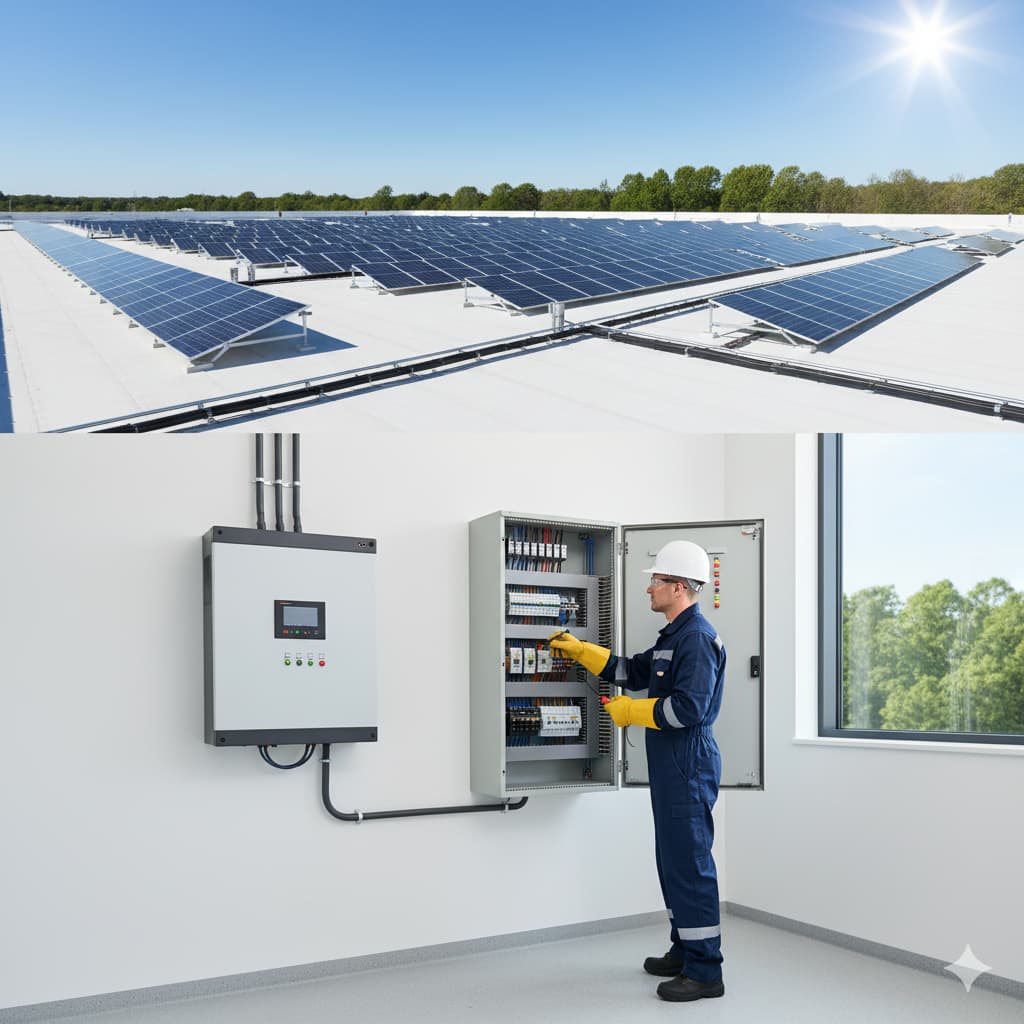
If your factory, hospital, warehouse or institution is planning solar in 2026, the first question is no longer whether solar saves money. It clearly does. The real question is which route you should use to buy that solar power: a rooftop plant on your own premises, an open access supply from a large solar park, or a group captive structure where you co-own a share of an offsite plant. Each route has different economics, different regulatory treatment, and different risks, and the right answer depends on your load, your roof, your capital appetite and your state. At MGetEnergy we help commercial and industrial (C&I) buyers across the NCR and eight plus states make exactly this decision, and in this guide we lay out the same framework we use with our own clients.
The three routes, in plain terms
1. Rooftop captive solar
You install a solar plant on your own roof or land, you own it (outright or through financing), and the power feeds your own load directly. There is no wheeling through the grid for the self-consumed portion, so wheeling charges, cross subsidy surcharge and open access approvals simply do not apply to it. Any surplus is settled with the DISCOM under the metering regime your state allows. This is the structure behind most of the plants we engineer and build across the NCR: the simplest to set up, the fastest to commission, and the one where you keep the entire savings. Its limits are physical: your roof or land area caps the plant size, and your capex or financing capacity caps how much of it you can build. For a sense of what larger captive plants cost today, see our 1 MW solar plant cost guide for 2026.
2. Third party open access
A developer builds and owns a large solar plant elsewhere in your state (or another state), and you sign a long term power purchase agreement to buy its output. The power is delivered over the existing grid, and you pay the DISCOM and transmission utility a set of regulated charges for using their wires: transmission and wheeling charges, cross subsidy surcharge (CSS), additional surcharge, banking charges and losses. Under the Green Energy Open Access Rules, any consumer with 100 kW or more of load is eligible in principle, applications run through the national GOAR portal, and approval timelines are capped. You put in little or no capex, but you also share the savings with the developer, and in the route evaluations we run for clients, the surcharge line is usually what decides whether this option works in a given state.
3. Group captive
Group captive is the structure that changes the surcharge math. Under the Electricity Rules, if consumers collectively hold at least 26 percent of the equity in a generating plant and consume at least 51 percent of its power in proportion to their shareholding, the plant qualifies as a captive generating plant. Captive users are exempt from cross subsidy surcharge and additional surcharge, which are usually the two largest open access charges. In practice, a developer typically holds 74 percent of the plant and you (often along with other consumers) hold 26 percent, so your upfront investment is a fraction of the plant cost while the surcharge exemption flows to every unit you consume. The trade off, and we say this plainly to every client who asks, is compliance discipline: the shareholding and consumption tests are verified every year, and if the 26 percent or 51 percent conditions slip, the captive status and the exemptions can be lost retrospectively for that year.
What changed in 2026, and why timing now matters
Three regulatory shifts this year directly affect which route wins for a given buyer.
The inter state transmission waiver is stepping down. Solar projects that supply consumers across state lines have enjoyed a waiver of inter state transmission system (ISTS) charges for years. That waiver is now on a published glide path: projects commissioned up to 30 June 2025 keep a 100 percent waiver, the window from July 2025 to June 2026 got 75 percent, projects commissioned from 1 July 2026 to 30 June 2027 get only 50 percent, the following year drops to 25 percent, and after 30 June 2028 the waiver is gone. We are now inside the 50 percent window. Every quarter of delay pushes new inter state supply toward higher landed costs, which is steadily tilting the market toward in state open access and group captive plants, and it strengthens the case for locking terms sooner rather than later.
Uttar Pradesh just made multi consumer open access easier. In 2026 the UP Electricity Regulatory Commission issued a removal of difficulty order under its open access framework that is aimed squarely at group structures. Applications routed through a lead green energy open access consumer now pay a rationalised per consumer application fee instead of each consumer paying the full standalone fee, and the mandatory check meter requirement has been relaxed for connections up to 650 volts, with the main meter treated as sufficient. For clusters of mid size units in the NCR industrial belts, Greater Noida, Noida, Ghaziabad and along the expressway corridors, these two changes remove real cost and paperwork barriers that previously made group captive and aggregated open access hard to justify below a few megawatts.
Metering and banking rules are tightening. The direction of travel in policy is away from generous net metering and liberal annual banking, and toward net billing, time of day settlement and monthly banking caps. UP introduced tighter banking limits for renewable captive plants under its 2024 captive and renewable energy regulations, and UP also charges banking at 6 percent of banked energy, which is triple the 2 percent most states levy. We covered what the metering shift means for savings in our explainer on the 2026 net metering changes for C&I solar. The practical effect: routes and plant sizes that depend heavily on banking large surpluses are becoming less attractive, and right sizing the plant to your real consumption profile matters more than ever.
The decision framework: five questions that pick your route
When we sit down with a client, the route usually falls out of five questions.
1. How big is your load, and how steady is it? Below roughly 100 kW of sanctioned load, open access is generally not available at all, so rooftop captive is the route by default. From about 100 kW to 1 MW, rooftop usually still wins if the roof supports it, because open access charges and compliance overhead weigh heaviest on small volumes, though UP's new aggregation route means a cluster of smaller units can now consider group structures earlier than before. Above 1 MW of load, especially with high annual consumption, offsite routes start to compete strongly because plant scale drives the generation cost down.
2. How much roof or land do you actually have? A useful rule of thumb is that 1 MW of rooftop solar needs roughly 8,000 to 10,000 square metres of usable shadow free roof. Many plants we survey in the NCR can host only 30 to 60 percent of the solar capacity their load could absorb. In those cases the answer is often both: fill the roof first, because self consumed rooftop power avoids wheeling and surcharges entirely, then serve the remaining load through open access or group captive.
3. How much capital do you want to deploy? Rooftop captive under a capex model needs the full plant investment but delivers the deepest per unit savings. A rooftop opex or PPA model needs no capex but shares savings with the investor. Third party open access needs little or no capex. Group captive sits in between: the 26 percent equity stake is a real investment, but it is a fraction of full plant cost and it unlocks the surcharge exemption that pure third party supply cannot.
4. Which charges apply to you in your state? This is where the routes separate. Self consumed rooftop power attracts none of the open access charges. Third party open access attracts all of them. Group captive is exempt from CSS and additional surcharge but still pays transmission, wheeling, banking and losses. In a state where CSS and additional surcharge together run above one rupee per unit, the group captive exemption alone can decide the comparison.
5. How long can you commit? Open access and group captive contracts typically run 15 to 25 years, and the group captive equity stake ties you in further. If your facility may relocate, downsize or see major load changes within a decade, a rooftop plant you own (which stays useful as long as the site does) or a shorter flexible arrangement may fit better than a long offsite PPA.
A representative Greater Noida comparison
Consider a representative mid size manufacturer in Greater Noida with a 2 MW sanctioned load, running about 5.5 lakh units a month on an 11 kV industrial connection, with roof space for about 800 kWp of solar. Numbers below are indicative planning ranges, not quotations.
On the UP grid, an industrial consumer at this level pays energy charges in the broad range of 6.5 to 7.5 rupees per unit under the UPERC tariff order for FY 2026, before demand charges. That is the benchmark every solar route is beating.
| Factor | Rooftop captive (800 kWp) | Third party open access | Group captive |
|---|---|---|---|
| Capex required | Full plant cost (or zero under opex model) | Nil to minimal | 26 percent equity stake in plant SPV |
| Effective generation cost | Lowest, roughly 2.5 to 3.5 rupees per unit levelised under capex | PPA tariff, commonly 3 to 4.5 rupees per unit | PPA tariff plus return on equity stake |
| Grid charges on solar units | None on self consumed units | Transmission, wheeling (about 1 rupee per unit in UP for FY 2026), CSS, additional surcharge, 6 percent banking, losses | Transmission, wheeling, 6 percent banking, losses; CSS and additional surcharge exempt |
| Share of load it can serve | Capped by roof, here roughly 20 to 25 percent of consumption | Up to full eligible load | Up to full eligible load |
| Typical net savings vs grid | Deepest per unit | Meaningful but surcharge sensitive | Usually the strongest offsite economics |
| Commitment | Asset life 25 years on your site | 15 to 25 year PPA | 15 to 25 year PPA plus equity and annual captive compliance |
Table compiled from the Green Energy Open Access framework, the UPERC tariff order and open access regulations in force during 2025-26, and indicative market ranges. Charges and tariffs change with every regulatory order; always verify the current orders for your DISCOM and consult your advisors before committing.
For this representative buyer, the answer we would usually reach is a sequence, not a single pick: build the 800 kWp rooftop first, because those units carry no grid charges at all and pay back fastest, then take the remaining 75 to 80 percent of load to a group captive evaluation, where the CSS and additional surcharge exemption typically makes the offsite economics work in UP despite the 6 percent banking charge. Pure third party open access remains the fallback where a buyer wants zero equity participation and accepts thinner savings.
Where batteries fit in this decision
Storage is increasingly part of the same conversation, because time of day tariffs and tighter banking push value toward evening consumption. If you are weighing whether a battery belongs alongside any of these routes, our five factor BESS decision framework for C&I buyers walks through the screening questions, and our CFO guide to solar plus storage avoided cost covers the financial model. The short version: the tighter your state's banking regime, the more a battery substitutes for the banking the grid no longer offers.
How MGetEnergy approaches this
We are an engineering led solar EPC with 45+ MWp delivered across 400+ projects in 8+ states, headquartered on Greater Noida home turf, and we work on the buyer's side of the table for procurement decisions like this one. Our process starts with your load data and roof survey, not with a product. We model all three routes on your actual consumption profile and the charges in force for your DISCOM, we build and commission rooftop plants ourselves, and for offsite routes we structure open access and group captive procurement for clients, help you evaluate and negotiate developer term sheets, and run the procurement process on your side of the table so the comparison stays honest. If your facility is in Greater Noida or the wider NCR, our Greater Noida C&I buyer's guide covers how to select an EPC partner, and our PPA and group captive service page explains the offsite offering. To find out which route fits your load, contact MGetEnergy today for a route comparison built on your own consumption data.
Frequently asked questions
What is the minimum load needed for open access solar in 2026?
Under the Green Energy Open Access Rules the eligibility threshold is 100 kW of load, and consumers can also aggregate multiple connections to reach it. States apply the framework with variations, so the practical minimum in your state depends on how your regulator has adopted the rules. Below the threshold, rooftop captive solar is the available route.
What makes a plant qualify as group captive?
Captive users must collectively hold at least 26 percent of the plant's equity and consume at least 51 percent of its generation, in proportion to their shareholding, on an annual basis. Meeting both tests exempts the consumers from cross subsidy surcharge and additional surcharge. The status is verified each year, and falling short can cost the exemption for that year.
Is group captive better than third party open access?
Where cross subsidy surcharge and additional surcharge are significant, group captive usually delivers stronger savings because it is exempt from both, in exchange for a 26 percent equity investment and annual compliance. Third party open access suits buyers who want no equity participation and accept a thinner margin. The comparison should always be run on your state's current charges.
Should we fill our rooftop before considering open access?
In most cases, yes. Self consumed rooftop power avoids transmission, wheeling, surcharges and banking charges entirely, so it is normally the cheapest tranche of solar available to you. The usual sequence is rooftop first up to the roof limit, then offsite routes for the remaining load.
How does the ISTS waiver phase out affect my decision?
Projects commissioned from July 2026 to June 2027 receive only a 50 percent waiver of inter state transmission charges, falling to 25 percent the next year and zero after June 2028. This mainly raises the landed cost of buying from plants in other states, which favours in state open access and group captive plants and rewards moving earlier rather than later.
What did UP change for open access in 2026?
UPERC issued a removal of difficulty order that rationalised application fees for multi consumer green energy open access routed through a lead consumer and relaxed the check meter requirement for connections up to 650 volts. Both changes lower the entry cost for group captive and aggregated open access in Uttar Pradesh, which is especially relevant for NCR industrial clusters.
Can we combine rooftop, open access and a battery?
Yes, and many of the strongest 2026 configurations do exactly that: rooftop up to the roof limit, an offsite route for the balance load, and storage where time of day tariffs or tight banking rules reward shifting solar energy into evening hours. The right mix comes out of your load profile, your roof survey and the charges in force for your DISCOM.
Disclaimer: This article is for general information only and reflects regulations, orders and market ranges in force or reported during 2025-26. Tariffs, charges, waivers and eligibility rules change with regulatory orders and vary by state and DISCOM. Figures shown are indicative planning ranges, not quotations. Always verify the current orders for your state and consult your legal, tax and financial advisors before making procurement decisions.