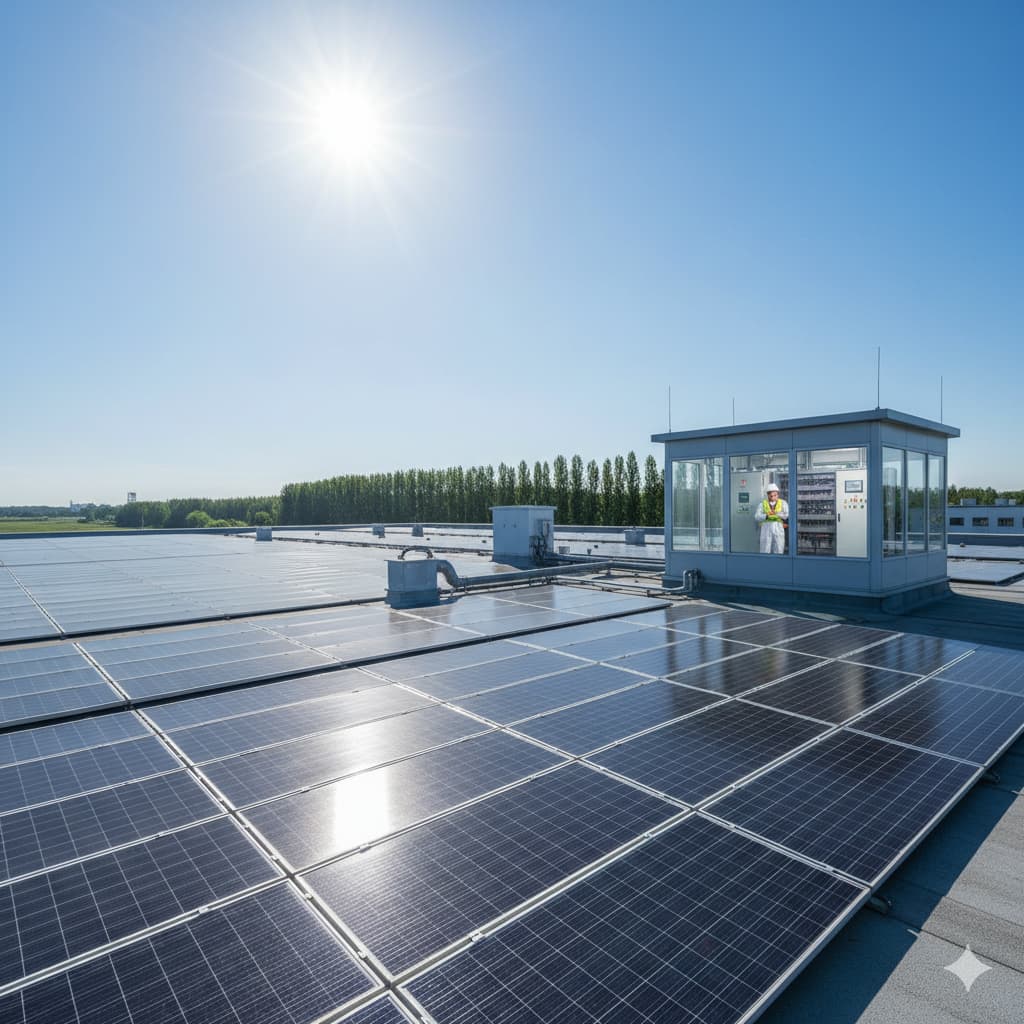
If you run a factory, warehouse, or industrial facility in India, the first number your CFO will ask for is the one you're here to find: what does a 1 megawatt (MW) solar power plant actually cost?
The short answer: Rs 3 crore to Rs 4 crore, all-in, for a CAPEX-owned 1 MW solar plant in India in 2026, using Tier-1 N-type TOPCon bifacial modules rated 625 Wp or higher, Tier-1 100 kW string inverters, full Balance of System, installation, commissioning, and composite GST at 8.9%.
This guide breaks down every line item, shows the 25-year math, and tells you what documents you need to provide, and what you should expect in return.
Pricing Disclaimer
Prices quoted here are for Non-DCR Tier-1 modules as of 15 April 2026 and reflect MGetEnergy's current commercial offer for industrial CAPEX projects. Module prices, BOS costs, GST rates, and state solar policies evolve continuously; any decision should be validated against a fresh, site-specific proposal. Non-DCR modules are the standard for industrial C&I projects because DCR compliance is primarily relevant to residential and specific government-subsidised schemes, which don't apply to industrial captive solar.
What a 1 MW Solar Plant Means for Your Facility
A 1 MW (1,000 kWp) solar plant has a peak DC capacity of one megawatt under standard test conditions. In practical terms:
- Daily generation: 4,000 to 4,500 units (kWh)
- Annual generation: 14 to 16 lakh units per year, depending on location
- Grid offset: 35 to 50% of a typical medium industrial facility's daytime consumption
- Plant life: 25 years, with module performance warranted above 87% at year 25
A 1 MW plant is the right size for industrial units consuming 2 to 3 lakh units per month: automotive component plants, mid-size textile mills, cold storage, pharma manufacturing, steel re-rolling, food processing, and large commercial campuses.
1 Megawatt Solar Power Plant Cost in India 2026: Rs 3 to Rs 4 Crore
MGetEnergy's 2026 pricing for a standard 1 MW industrial CAPEX project:
- Base EPC rate (Non-DCR, 15-Apr-2026): Rs 32,000 / kW → Rs 3.20 Cr per MW
- Composite GST @ 8.9%: Rs 2,848 / kW → Rs 28.48 L per MW
- All-in CAPEX: Rs 34,848 / kW → Rs 3.48 Cr per MW
This is the captive, owned-asset number. You hold the asset on your balance sheet; you keep every rupee of savings.
What's included
Tier-1 N-type TOPCon bifacial modules (625 Wp or higher, Non-DCR), Tier-1 100 kW string inverters (10 units for 1 MW), hot-dip galvanised mounting, DC/AC cabling and BOS, HT/LT switchgear, ABT-compliant metering, earthing and lightning protection, SCADA and remote monitoring, civil foundations, installation, testing, commissioning, DISCOM liaisoning, and composite GST.
What is NOT included: priced separately based on site
- Step-up transformer: may or may not be required depending on existing infrastructure
- Battery Energy Storage System (BESS): additional scope, priced per backup and peak-shaving requirement
- DG synchronisation: additional scope, priced based on number, rating, and configuration of existing DG sets
- Land (if purchasing fresh for ground-mount)
- HT line extension beyond standard scope
- Structural strengthening of old rooftops
A quote above Rs 4 crore per MW deserves negotiation. A quote meaningfully below Rs 3 crore deserves hard questions about module tier, cell technology, inverter brand, BOS quality, and warranty terms.
Component Breakdown: Where the Rs 3 to 4 Crore Goes
Rule of thumb: solar modules and inverters together account for approximately 70% of the total project cost. The remaining 30% covers mounting, BOS, electricals, civil work, and installation.
- Solar modules (Tier-1 Non-DCR, 625 Wp or higher): 55 to 60% → Rs 1.90 to 2.10 Cr
- Inverters (10 × 100 kW string): 10 to 15% → Rs 35 to 52 L
- Subtotal: Modules + Inverters: ~70% → ~Rs 2.44 Cr
- Mounting structure (HDG): 7 to 9% → Rs 24 to 31 L
- DC/AC cabling, combiner boxes, BOS: 6 to 8% → Rs 21 to 28 L
- HT/LT switchgear, metering, protection: 4 to 6% → Rs 14 to 21 L
- Civil work & foundations: 4 to 6% → Rs 14 to 21 L
- SCADA, monitoring, safety: 2 to 3% → Rs 7 to 10 L
- Installation, testing, commissioning: 5 to 7% → Rs 17 to 24 L
- Engineering, approvals, PMC: 2 to 3% → Rs 7 to 10 L
Solar modules: where half the budget goes
The market has moved decisively to N-type TOPCon bifacial modules at 625 Wp or higher, replacing the 540 to 580 Wp Mono PERC panels that dominated 2022 to 2024. Current-generation Tier-1 modules deliver 23%+ efficiency, with some lines now producing up to 645 Wp. Three practical buyer implications:
- Fewer panels per MW. ~1,600 panels at 625 Wp versus ~1,850 at 540 Wp: less mounting, less cabling, faster commissioning.
- Smaller footprint. 15 to 20% less land, which is why a modern 1 MW ground-mount fits in 3.25 to 4 acres instead of the older 4 to 5 acre benchmark.
- Better 25-year economics. Lower temperature coefficients (less output loss in summer heat), better low-light behaviour, plus 5 to 10% bifacial gain on ground-mount installations.
Inverters: 10 × 100 kW string configuration
MGetEnergy specifies ten 100 kW string inverters for a 1 MW plant rather than one central 1 MW unit. The reasons are operational:
- Redundancy: a single inverter failure takes down only 10% of capacity, not the whole plant
- More MPPT trackers: 60+ independent optimisation zones across the array
- Serviceability: at under 100 kg, a 100 kW inverter can be swapped by two technicians without cranes
- Transformerless, IP66 outdoor-rated, 98.5%+ efficiency: no separate isolation transformer needed for the inverter itself
Transformer: May Be Required, or May Not Be
Transformer need is the most genuinely site-dependent variable in a 1 MW project:
- Existing HT connection with adequate transformer capacity; rooftop solar ties in at LT side → Not required. Inverters feed directly into existing LT bus.
- Facility on LT-only connection, requiring HT upgrade for 1 MW solar → New step-up transformer required.
- Ground-mount plant at distance from main load, evacuating to HT grid → Step-up transformer required (typically 1250 kVA).
- Existing transformer near capacity; solar addition would overload it → Upgrade or dedicated solar transformer required.
The site assessment establishes this definitively. Don't accept a transformer cost on an initial quote without first checking whether your existing infrastructure can handle tie-in.
Timeline: 120 to 150 Days
From PO to commissioning, a 1 MW industrial CAPEX project takes 120 to 150 days, subject to DISCOM responsiveness and site conditions:
- Weeks 1 to 3: Site survey, structural/geotech analysis, detailed engineering, SLD finalisation
- Weeks 4 to 6: DISCOM application, technical feasibility approval, material procurement
- Weeks 7 to 14: Civil work, mechanical and electrical installation
- Weeks 15 to 18: Testing, DISCOM synchronisation, commissioning
- Weeks 19 to 22: Performance Ratio testing, documentation, handover
Land: 3.25 to 4 Acres for Ground-Mount
A common planning error: assuming 1 MW still needs 5 acres. With 625 Wp+ modules and modern high-density mounting, a 1 MW ground-mount plant sits in 3.25 to 4 acres.
- Rooftop (industrial PEB shed): 75,000 to 90,000 sq ft, shadow-free, structurally sound
- Ground-mount (open land): 3.25 to 4 acres
Check two things before the site visit: shadow-free exposure from 9:00 AM to 4:30 PM through the year, and (for rooftop) a structural consultant's clearance on dead load; solar adds 15 to 20 kg/m².
GST: Composite 8.9%
GST on a turnkey solar EPC contract in India is composite 8.9%. For a Rs 3.20 crore base EPC, this adds Rs 28.48 lakh, bringing all-in to Rs 3.48 crore. If a vendor quotes GST meaningfully different, ask for the basis before signing.
Net Metering vs Gross Metering: State-Dependent
India's net metering rules are state-specific. A 1 MW plant may qualify for net metering in some states and be required to use gross metering in others. Current 2026 caps for industrial net metering:
- Up to 2 MW: Uttar Pradesh, Jharkhand
- Up to 1 MW: Gujarat, Karnataka, Rajasthan, Andhra Pradesh, Telangana, Kerala, Assam
- Up to 500 kW: Maharashtra, Haryana, Punjab, Bihar, Odisha, Madhya Pradesh, Goa
- Net billing up to 1 MW: Tamil Nadu, West Bengal
Why this matters: in a state with a 500 kW cap, a 1 MW plant should ideally be sized to match daytime consumption (so little is exported), or the exported units settle at a lower feed-in tariff under gross metering. Plant economics still work; the assumptions simply shift. Any serious proposal must be grounded in your state's current policy, not a pan-India average.
Ownership Models: CAPEX, OPEX, Group Captive
- CAPEX: You own 100%. Upfront ~Rs 3.48 Cr. Effective rate Rs 2.0 to 2.2/kWh. Savings ~75% vs grid. Payback 3.5 to 4 years. Best for max ROI and full control.
- OPEX / PPA: Developer owns. Zero upfront. PPA rate Rs 4.5 to 5.5/kWh. Savings 35 to 45%. Lock-in 15 to 25 years. Best for zero CAPEX preference.
- Group Captive (26% equity): You 26% / Developer 74%. Upfront ~Rs 90 L. Effective rate Rs 3.5 to 4.5/kWh. Savings 45 to 55%. Payback 5 to 6 years. Lock-in 10 to 25 years. Best for balance of ownership and lower risk.
CAPEX gives the highest long-term return and full control. OPEX/PPA gives day-one savings with zero balance sheet impact. The right answer depends on your cost of capital and your five-year plan for the site.
ROI and Payback: The 3.5 to 4 Year Number
For a grid-connected 1 MW industrial CAPEX project offsetting power at Rs 8.50/kWh, simple payback lands between 3.5 and 4 years. Year-1 math:
- Annual generation (Year 1): ~15 lakh kWh
- Self-consumption (85%) at Rs 8.50: Rs 1.08 Cr
- Net metering export (15%) at Rs 3.00: Rs 6.75 L (export economics vary by state)
- Less: O&M (1% of CAPEX): Rs 3.48 L
- Less: deration / soiling / shutdowns: Rs 11 L
- Net Year-1 savings: ~Rs 1 Cr
- Simple payback: ~3.5 years
Over 25 years, with 0.5% annual module degradation and 6% annual tariff escalation, realised savings for a 1 MW CAPEX plant typically land between Rs 18 and Rs 20 crore, against an all-in investment of Rs 3.48 crore.
The hidden lever is tariff escalation. Industrial tariffs in India have risen at 5 to 7% compounded for a decade. Every rupee saved today against an Rs 8.50/kWh tariff is worth Rs 2 in 12 years when tariffs have grown to Rs 17/kWh. Solar isn't just a cost saving; it's a 25-year hedge against rising power costs.
Ongoing O&M
Annual O&M costs approximately 1% of CAPEX, escalating 3% per year, about Rs 3.5 lakh in year one rising to Rs 6 to 7 lakh by year twenty. It covers module cleaning, electrical and thermal inspections, inverter firmware and filter replacement, SCADA monitoring, consumables, and annual Performance Ratio testing.
Inverter replacement at year 10 to 12 is the one large mid-life cost to plan for. With 10 × 100 kW string units, replacements can be staggered rather than done all at once.
What Makes Costs Vary
- Rooftop vs ground-mount: rooftop is typically Rs 10 to 15 lakh cheaper per MW
- Transformer scope: Rs 15 to 30 lakh if new step-up transformer is required
- Distance to evacuation point: every 100 metres of HT cable beyond standard scope adds cost
- DG synchronisation scope: extra where DGs must run in parallel with solar
- Site complexity: old rooftops needing retrofit; rocky soil needing blasting; access-constrained sites
A good EPC walks you through all of these at design stage. A bad one surprises you on the invoice. Our turnkey solar EPC service covers each of these at design stage, before a price is fixed.
What We Need From You to Start
A credible 1 MW proposal needs a credible input set:
- Last 12 months of electricity bills: to analyse consumption, MDI trend, TOD pattern, power factor, effective tariff, PF rebate status
- Single Line Diagram (SLD): to identify tie-in point, assess HT/LT infrastructure, determine if a transformer is needed
- Critical load details: to separate backup-essential loads; shapes BESS sizing
- Transformer capacity and configuration: existing rating, vector group, tap-changer range determine interconnection design
- DG set details (if any): number, rating, configuration; needed to scope DG synchronisation
- Site plan / rooftop layout: to calculate usable area, shadow impact, installation access
- Contract Demand and sanctioned load: to assess CD alignment and DISCOM approval pathway
If these are ready, the proposal process compresses from weeks to days. If not, our site team helps you request the missing documents from your DISCOM. For facilities in Greater Noida and the wider NCR, our Greater Noida commercial solar page sets out how we work locally from our base in Kasna Industrial Area.
What You Get Back From MGetEnergy: Before You Commit a Rupee
This is where MGetEnergy differs from most EPC vendors. Before you're asked for an advance, and before any commitment beyond "please take a look", you receive a full investment-grade financial analysis report running to 18 to 20 structured sections:
- Executive Summary: headline KPIs, recommended capacity, payback, NPV, 25-year savings
- Monthly consumption analysis: 12 to 24 month trend, MoM variation, seasonal pattern
- Time-of-Day (TOD) zone breakdown: night, morning, day peak, evening peak shares
- Detailed cost breakdown: demand charges, energy, fuel surcharge, electricity duty, TOU, rebates
- Solar sizing comparison: side-by-side financials for 500 / 700 / 1000 / 1500 / 2000 kWp
- Recommended system design: configuration, BOQ, layout, module-inverter matching
- 25-year cash flow model: full DCF with NPV, IRR, LCOE, discounted payback
- Procurement model comparison: CAPEX vs OPEX vs Group Captive vs Open Access
- Contract Demand gap & compliance scorecard: CD utilisation, revision recommendations
- Carbon & ESG impact: annual CO₂ reduction, trees-equivalent, BRSR-aligned metrics
- Peer benchmarking: where your industry sits on solar adoption
- Cost of inaction: what every month of delay costs in lost savings
- Hourly load profile analysis: 24-hour demand vs solar generation overlay
- Financing scenarios: self-funded, term loan, green bond, hybrid structures
- BESS / storage optimisation: whether storage adds value for your load profile
- State solar policy: net metering, open access, banking, RPO, captive rules for your state
- Energy audit scope: BEE-aligned audit plan with short, medium, long-term recommendations
- Power factor & tariff escalation analysis: rebate trajectory and escalation impact
- Seasonal consumption pattern: summer/monsoon/winter demand profile
- Scenario modeling: sensitivity on tariff, generation, and CAPEX variables
This isn't marketing collateral. It's the document your CFO will base capital approval on: complete, transparent, source-referenced. To see a delivered system rather than a proposal, read our Shree Ganesh Frozen Foods case study: 135 kW of on-grid solar with a 30 kW / 48 kWh battery, commissioned in September 2024 and now under a five-year CAMC.
Frequently Asked Questions
How much does a 1 MW solar power plant cost in India?
A CAPEX-owned 1 MW plant is a crore-scale investment, and the range depends on module choice, inverter configuration, site conditions and whether a transformer is required. This guide sets out the current range with a full component breakdown. Every figure should be validated against a fresh, site-specific proposal at the time of decision.
How long does it take to build a 1 MW solar plant in India?
120 to 150 days from order to commissioning, covering design, procurement, civil and structural work, electrical installation, testing and utility approvals. Approval timelines vary by state and by DISCOM.
How much land does a 1 MW ground-mount solar plant need?
3.25 to 4 acres, depending on row spacing, terrain and shading. A rooftop plant of the same capacity uses existing roof area instead, which is why rooftop projects avoid the land cost entirely.
What GST applies to a solar power plant in India?
A composite rate of 8.9% applies to a turnkey solar EPC contract, reflecting the statutory split between the goods and the services components of the supply.
Is a transformer included in the cost of a 1 MW solar plant?
Not always. Whether one is needed depends on your existing electrical infrastructure and the evacuation voltage at your site, so it is priced separately rather than assumed into a headline figure. A site assessment establishes this before any proposal is issued.
What is the difference between CAPEX, OPEX and Group Captive for a 1 MW plant?
Under CAPEX you own the asset and take both the full benefit and the full risk. Under OPEX a developer owns the plant and you buy the power it generates. Group Captive is a structured ownership route carrying its own equity and consumption requirements. The right choice depends on your balance sheet and tax position rather than on which looks cheapest per unit.
Ready to See Your Numbers?
Every serious 1 megawatt solar project starts with a Free Site Assessment. No commitment, no pressure:
- Physical site visit by our technical team
- Rooftop structural / ground-mount feasibility report
- 18 to 20 section financial analysis based on your actual electricity bills
- Recommended capacity with CAPEX, OPEX, and Group Captive comparisons
- 25-year cash flow with NPV, IRR, and payback
- State-specific net metering / gross metering implications
Contact MGetEnergy to schedule your Free Site Assessment. Within 10 working days of sharing your 12-month bills, SLD, critical load, transformer details, and DG specs, you'll have a complete investment-grade report in hand.
Pricing in this article is based on Non-DCR Tier-1 modules as of 15 April 2026. Module prices, inverter prices, GST rates, and state policies evolve continuously; all figures should be validated against a fresh, site-specific proposal at the time of decision.