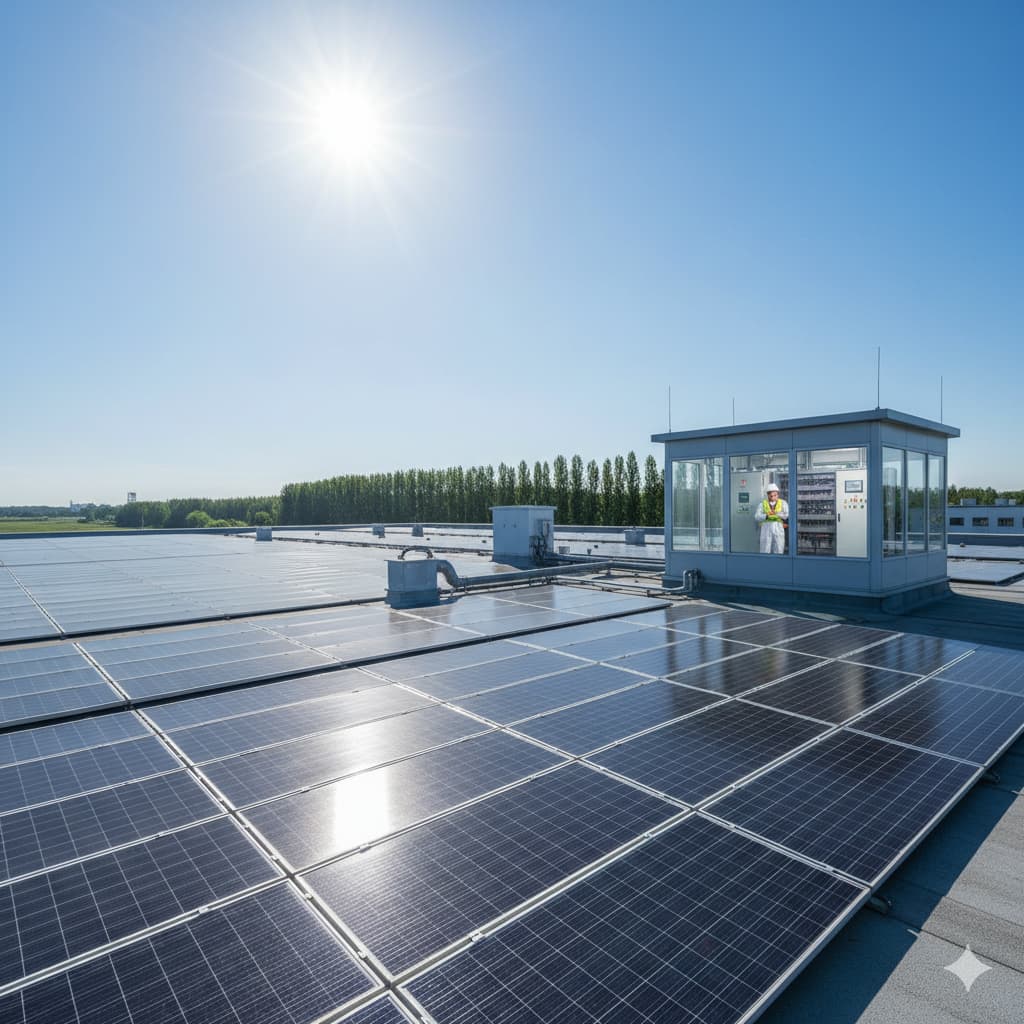
Two 1 MW rooftop plants. Same modules, same inverters, same installer, same design. One sits on a private auto components factory in Greater Noida. The other sits on a public sector refinery in the same district.
Under India's ALMM rules, those two plants are not treated the same way. The private one can use almost any module its owner chooses. The public sector one cannot, and from 1 January 2027 its options narrow again.
We work on both sides of that line, so this distinction is not academic for us. It decides what we can quote, what we must source, and how early a client needs to commit. This article sets out where the line sits, why it moved in July and August 2026, and what a buyer should do about it in the months that remain.
If you want the background on what ALMM is and how List-I and List-II differ, we covered that separately in our guide to the ALMM and DCR mandate for C&I buyers. This piece assumes you know the basics and goes straight to the question of which category your project falls into.
What changed in July and August 2026
Two orders matter.
On 18 July 2026, the Ministry of New and Renewable Energy issued Office Memorandum No. 283/53/2026-GRID SOLAR. It extended the exemption from ALMM List-II, the list governing solar cells, for net metering projects and open access renewable energy projects. Those categories can now be commissioned without List-II compliant cells up to 31 December 2026. The previous cut-off had been 31 May 2026.
MNRE was explicit that this is not a general rollback. The ministry stated there would be no change in policy on implementing List-II and no blanket extension for solar power projects at large. The window is limited to two categories, and it closes at the end of the year.
On 4 August 2026, MNRE followed with a clarification setting out how List-II applies across project types. That second document is the one most buyers have not read, and it is the one that answers the captive question.
The category table
Here is the position as it now stands.
| Project type | ALMM List-I, modules | ALMM List-II, cells |
|---|---|---|
| Captive behind the meter, private consumer or group of consumers | Does not apply | Does not apply |
| Captive behind the meter, government entity or public sector enterprise | Applies now | Exempt if commissioned by 31 December 2026, applies after |
| Net metering | Applies | Exempt if commissioned by 31 December 2026, applies after |
| Open access renewable energy projects | Applies | Exempt if commissioned by 31 December 2026, applies after |
| Residential rooftop under PM Surya Ghar with net metering | Applies | Exempt to 31 March 2027, subject to portal application |
Two features of that table deserve attention.
First, the exemption for net metering and open access applies whether the project started before or after 18 July 2026, and no prior approval is needed to use it. That removes a question we were asked repeatedly through August. There is no application, no case by case relief, no file to submit. If the plant is commissioned by 31 December 2026, the exemption applies.
Second, List-I never lapses for any category where it applies. The relief that was granted concerns cells, not modules. A buyer who reads "ALMM exemption" and concludes that any module will do has misread it.
Private captive sits outside ALMM altogether
The carve out for behind the meter captive plants is not new. MNRE established it in 2022 and has reaffirmed it since, most recently in the August 2026 clarification. A solar plant used solely for captive consumption by a consumer or a group of consumers, behind the meter, falls outside the ALMM framework. Not outside List-II only. Outside both lists.
For a private industrial buyer building a self consumption plant on their own premises, this is the most commercially significant fact in the entire ALMM framework, and in our experience it is the least understood.
It means module choice is a commercial and technical decision rather than a regulatory one. It means the December deadline that is driving urgency across the market does not apply to that project at all. It means the cost step up that other categories will absorb from January 2027 is avoidable.
It also comes with a condition that must be respected rather than assumed. The plant has to be genuinely captive and genuinely behind the meter. That means self consumption, no export settlement arrangement, no government scheme, no subsidy claim. A plant that is captive in intent but connected under net metering for surplus export is a net metering project, and net metering projects are covered.
The trap: group captive is not behind the meter
This is the point where we have seen buyers, and some suppliers, get it wrong.
The ALMM carve out refers to captive consumption by a consumer or a group of consumers, behind the meter. The phrase "group of consumers" describes several consumers sharing a plant on site, for example within an industrial estate, with no power wheeled across the grid.
Group captive as the term is normally used in the Indian market is a different structure. It is an open access arrangement, with the generating plant at one location and consumption at another, power wheeled through the distribution network, with the 26 per cent equity and 51 per cent consumption conditions attached.
That structure is open access. Open access is covered by ALMM. It gets the 31 December 2026 window on cells, and full List-I and List-II compliance from 1 January 2027.
The words are similar. The regulatory treatment is not. If a supplier tells you that your group captive project is exempt from ALMM because it is captive, ask them to point to the provision, because we do not believe one exists.
Public sector captive: same plant, different rules
Government entities, central and state public sector enterprises, and central and state autonomous bodies are treated separately throughout the ALMM framework. The 2022 behind the meter carve out was explicitly limited to private consumers and does not extend to them.
For a captive behind the meter plant at a government or PSE site, the position is:
- ALMM List-I applies now. Modules must be on the approved list.
- ALMM List-II is exempt for plants commissioned on or before 31 December 2026.
- From 1 January 2027, both lists apply.
We do a substantial share of our work for public sector clients, and this split timeline is the single item we are raising in every current conversation. A PSU captive plant that slips past December does not simply cost more. It requires a different module supply chain, sourced from manufacturers whose cells are enlisted under List-II, and that sourcing needs to be arranged in advance rather than discovered at procurement stage.
The practical consequence is that the binding date is not the installation date. It is the commissioning date, which in public sector projects depends on inspection scheduling, metering, and documentation that the vendor does not fully control. Anyone planning to land inside the window needs to work backwards from a realistic commissioning certificate date, not forwards from a start date.
What DCR does, and does not, change
MNRE stated in the August clarification that these provisions do not alter Domestic Content Requirement obligations under government schemes. DCR continues to be governed by the guidelines of each scheme.
The two frameworks are often confused because both concern domestic manufacturing. They are separate. A project can be outside ALMM and still be subject to DCR because of the scheme it draws support from, and a project can satisfy DCR and still need to check its ALMM position. Where a scheme imposes DCR, that requirement stands on its own terms.
What a buyer should do in the months that remain
For projects that can realistically be commissioned this year, the practical steps are:
- Establish which category the project is in, in writing, before ordering modules. The category determines everything else.
- For net metering and open access projects, work backwards from a commissioning certificate date with buffer built in for DISCOM inspection and meter sealing. December is likely to be congested.
- For public sector captive projects, confirm the List-I position now and treat the List-II date as fixed.
- For genuinely private captive projects, confirm with your EPC that the structure will remain outside net metering and outside any scheme, then treat module selection as a technical and commercial choice.
For projects that will land in 2027, the decision moves upstream. Module sourcing has to be planned against List-II enlisted supply, and the structure of the project itself becomes a lever. A private buyer who can consume what they generate on site has an option that a net metering project does not.
What to ask your EPC
Whichever category you are in, three questions are worth putting to any supplier before you sign.
Which ALMM category does this project fall into, and on what basis? The answer should name the category and the reason, not simply assert that the project is exempt. If a supplier tells you a group captive project is exempt because it is captive, ask them to identify the provision.
What commissioning date is this quote built on? For net metering, open access and public sector captive work, the December date attaches to commissioning, not installation. A schedule that reaches installation in December has almost certainly missed the window.
If the date is missed, who carries the cost? Module sourcing changes on 1 January 2027 for every covered category. Whether that cost sits with the buyer or the contractor is a question worth settling in the contract rather than in an email afterwards.
We would also say plainly that we do not treat a further extension as the base case. The date moved once, from May to December, and MNRE has said since that it does not intend to move it again. A project plan that depends on a third extension is carrying a risk that nobody has agreed to.
Frequently Asked Questions
Is my captive solar plant exempt from ALMM?
If it is behind the meter, used solely for your own consumption, you are a private consumer or group of consumers, and it is not under any government scheme, then both ALMM List-I and List-II are outside its scope. If the consumer is a government entity or public sector enterprise, the exemption does not apply and List-I applies now, with List-II applying from 1 January 2027.
Does the ALMM exemption cover group captive projects?
Not on the basis of being captive. Group captive as commonly structured in India is an open access arrangement with power wheeled through the grid, and open access projects are covered by ALMM. Such projects are exempt from List-II only if commissioned on or before 31 December 2026, and List-I applies throughout.
Do I need to apply for the net metering exemption?
No. MNRE clarified in August 2026 that the exemption applies without prior approval and irrespective of whether the project was initiated before or after 18 July 2026. The condition is commissioning on or before 31 December 2026.
What happens to my project if it is commissioned in January 2027?
For net metering, open access, and government or PSE captive projects, both ALMM List-I for modules and ALMM List-II for cells will apply. In practice that narrows module choice to products built with cells from List-II enlisted manufacturers.
Is the deadline likely to be extended again?
MNRE stated in the July 2026 memorandum that there would be no change in policy and no blanket extension. We plan on the basis that 31 December 2026 holds, and we would advise any buyer to do the same. Treating a further extension as the base case is a risk that sits with the project, not with the ministry.
Does the exemption mean I can use any module?
No. The relief concerns solar cells under List-II. Wherever List-I applies, modules must still be on the approved list. The only category where neither list applies is private captive behind the meter.
Does this change DCR requirements?
No. MNRE confirmed that DCR provisions under government schemes are unaffected and continue to be governed by the guidelines of each scheme. ALMM and DCR are separate frameworks and a project may be subject to one, both, or neither.
This article reflects MNRE orders as published up to 17 August 2026. ALMM lists and clarifications are revised regularly. Confirm the current position for your project before making procurement decisions, and consult your own advisers on contractual risk.