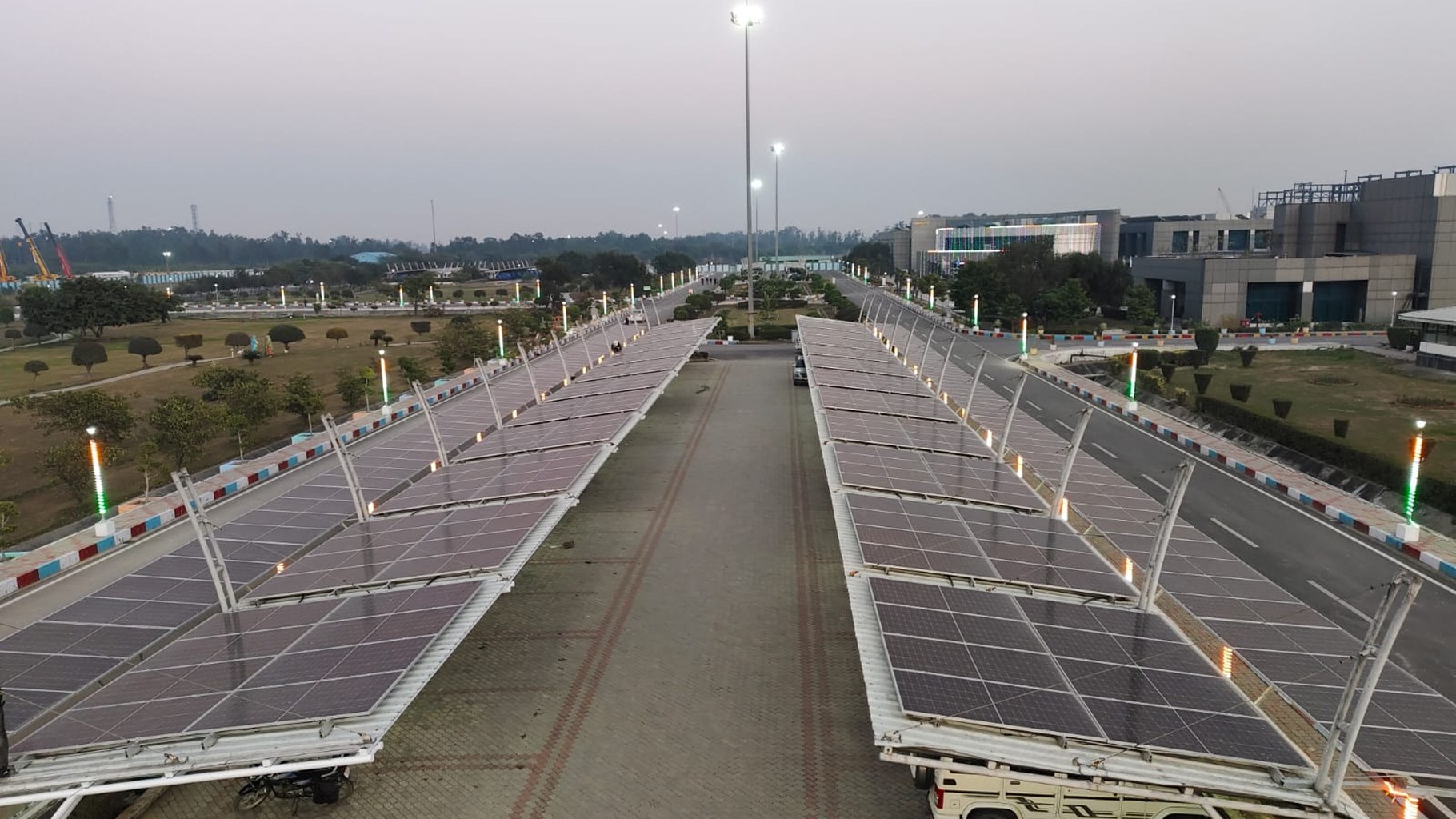
A working tour of what a comprehensive solar maintenance contract looks like inside an operating refinery complex in North India - written for procurement teams scoping their own RFPs.
The Contract in One Paragraph
In early 2026, MGetEnergy mobilised a 24-month Annual Rate Contract (ARC) for solar servicing and repair across an operating PSU refinery complex in North India. The portfolio covers approximately 3 MWp aggregate across 32 installations spread over three process complexes - a naphtha cracker unit, the main refinery, and an aromatics (PX-PTA) plant. The contract structure is not a conventional lump-sum comprehensive O&M deal: it is a rate-based ARC, with individually priced line items for daily monitoring, preventive servicing, inverter repair, component replacement, and supply-installation-testing-commissioning (SITC) of new equipment. The scope spans six distinct mounting typologies, multiple inverter ratings between 15 kW and 50 kW, and a floating solar installation - which makes the technical envelope unusually broad for a single contract.
What follows is a procurement-grade walkthrough of how a contract like this is actually scoped, mobilised, and run.
Why Refinery Solar O&M Is Different
Solar O&M outside the fence line - at warehouses, factories, commercial complexes - is largely a function of cleaning frequency, generation reporting, and timely component replacement. Inside an operating refinery, the same work happens against a layered constraint system that fundamentally changes the operating model.
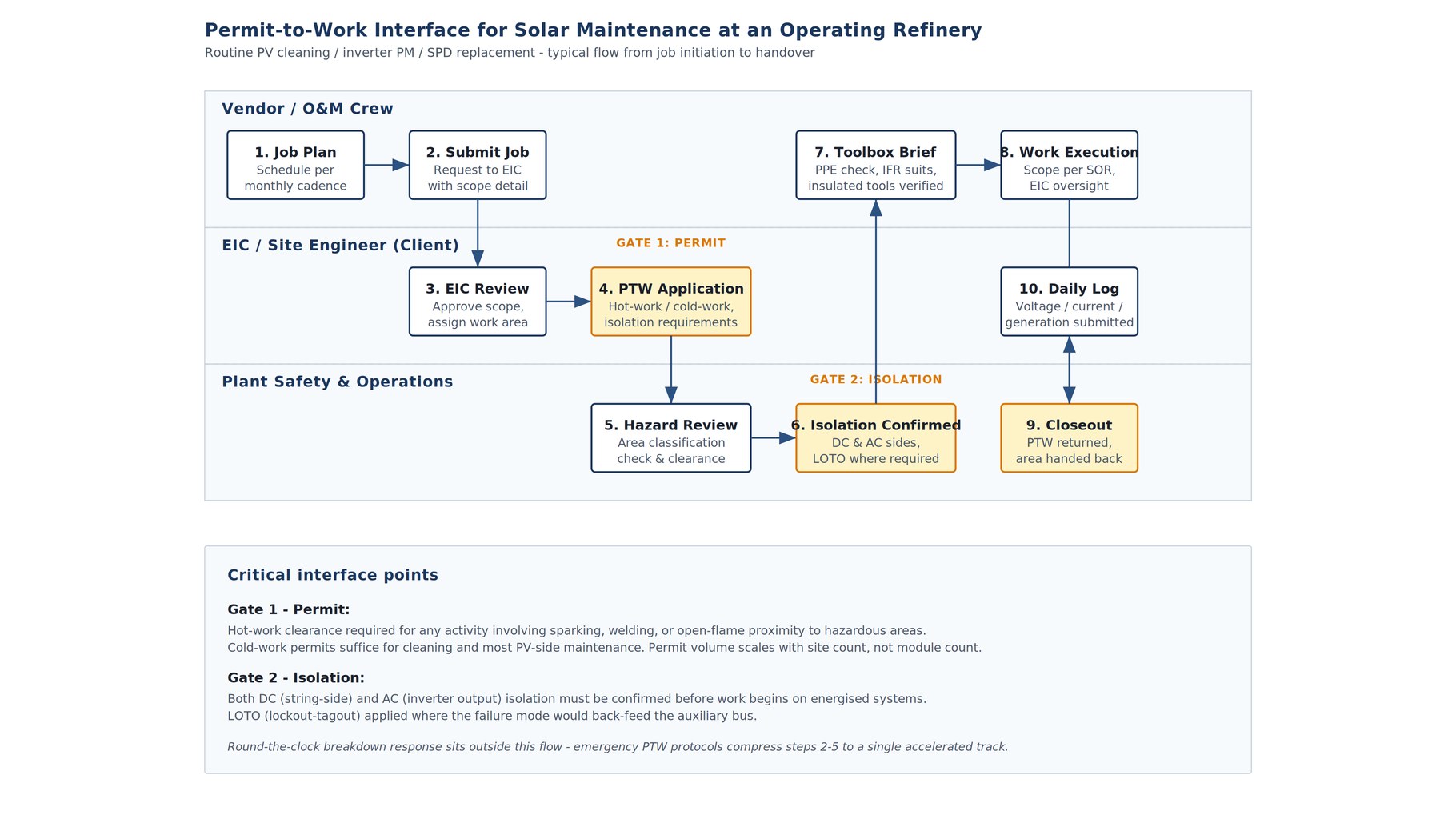
Area classification governs everything. Sections of a naphtha cracker complex are classified hazardous areas under petroleum industry safety standards. Any electrical or mechanical work inside these zones requires Inherently Flame Resistant (IFR) coveralls, insulated tools, and explosion-protection awareness in tool selection. The refinery's existing Work Permit System (PTW) gates every job - solar maintenance crews cannot simply turn up at a substation rooftop and start cleaning panels. Permit application, hot-work clearance where applicable, isolation confirmation, and EIC-led toolbox briefings precede any physical work.
Twenty-four-hour breakdown response is a contractual obligation, not an aspiration. Solar installations at PSU process plants are tied into substation auxiliary loads or running into colony/township feeders. An inverter failure that would be tolerated overnight at a warehouse cannot sit unattended here. The contract therefore specifies that the vendor shall attend breakdown jobs immediately for repair, replacement, or adjustments and complete at the earliest - with round-the-clock site availability and no incremental financial implication.
The host plant provides no consumables, tools, or tackles. Every item from cleaning brushes and motorised mopping equipment to insulated screwdrivers, multimeters, insulation testers, and laptop interfaces for inverter diagnostics is mobilised and maintained by the vendor. Site office space and material storage construction is also vendor scope - the refinery provides only open space; the contractor builds the shed, secures it, and absorbs every rupee.
Safety violation penalties are real and immediate. Penalty clauses cascade from the refinery-specific Special Conditions of Contract (SCC), the General Conditions of Contract (GCC), and the Environmental Management System SCC. Engineers-in-Charge have explicit authority to stop any job that deviates from specification and to reject work without arbitration. This is not the C&I rooftop world.
Procurement teams scoping refinery or process-plant solar O&M for the first time often under-estimate the cost of these constraints. A bid priced as if the work were rooftop O&M will lose money inside six months.
The Six Site Typologies and What Each Demands
The portfolio's distinguishing feature is structural diversity. Most O&M contracts in India cover one or at most two mounting typologies. This one covers six - each with its own inspection regime, corrosion exposure, cleaning protocol, and risk profile.
1. Substation Rooftops (RCC)
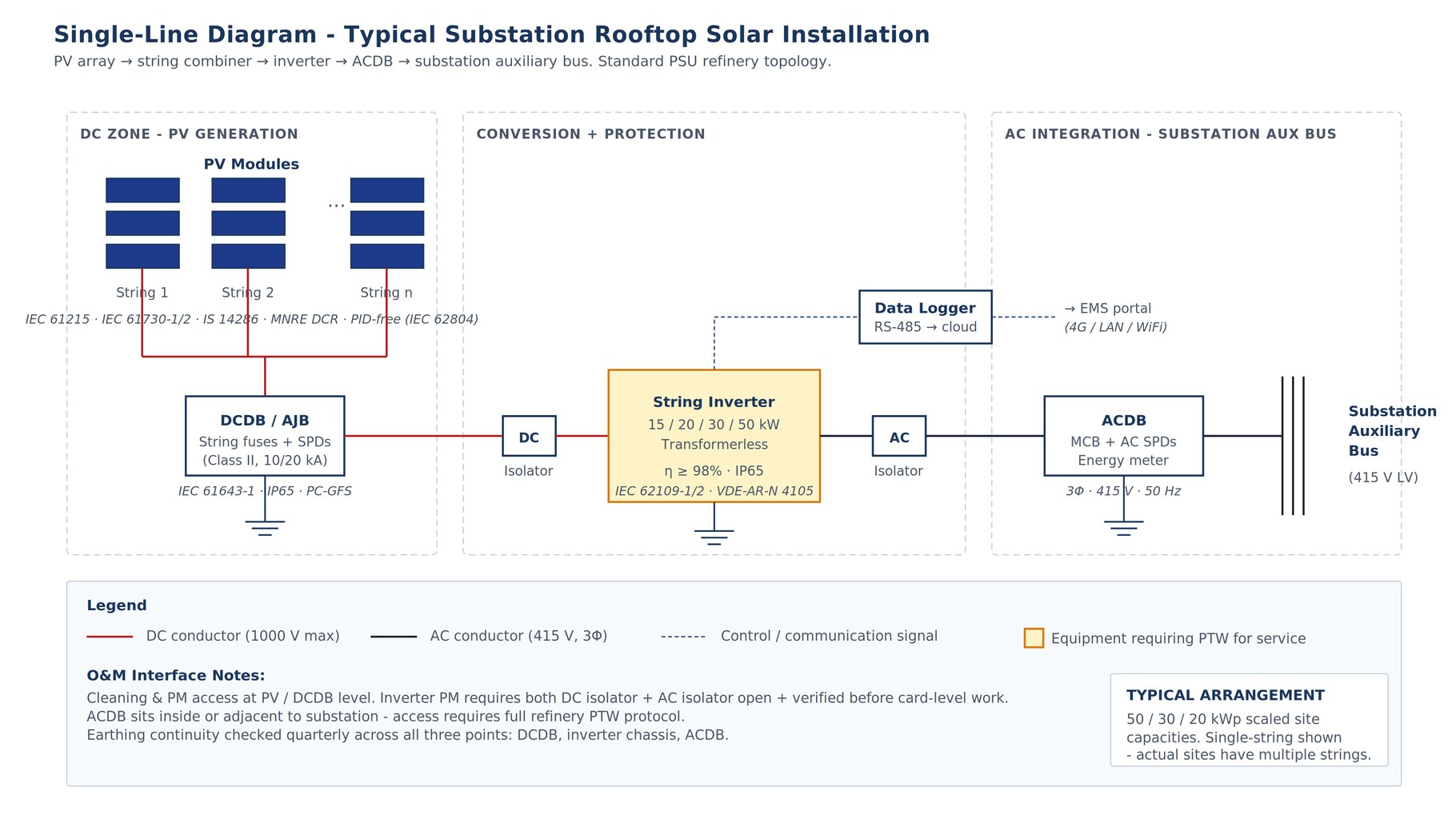
The largest typology by site count. Substation rooftops at PSU refineries host installations in the 50-130 kWp range, mounted on RCC roof slabs above live HV/LV electrical equipment. The dominant operational consideration is proximity to energised assets below. Cleaning water cannot be allowed to drip through expansion joints or service penetrations onto switchgear; structural drilling for any retrofit is prohibited without civil clearance. Inspection involves quarterly retorquing of structural nuts and bolts, monthly string current measurement to flag faulty strings, and continuous attention to cable terminations at array junction boxes.
2. Administrative Building Roofs
Two installations totalling around 240 kWp. Engineering profile is similar to substation rooftops, but the operational interface is different - these buildings have continuous occupancy, so cleaning hours and breakdown work require occupant coordination. Aesthetic and acoustic standards are tighter; noise from cleaning equipment matters.
3. Carport (Parking Area)
Two installations of roughly 100 kWp each, covering plant gate and admin parking. Carport mounting is structurally distinct from rooftop solar: taller column-supported steel frames, larger spans, vehicle-strike risk at column bases, and significantly higher soiling rates because of dust raised by vehicle movement. Cleaning frequency must be benchmarked against rooftop sites, not assumed equal. Quarterly structural inspection includes weld-line checks at column-to-truss junctions - a step omitted in many O&M scopes and quietly responsible for premature carport failures.
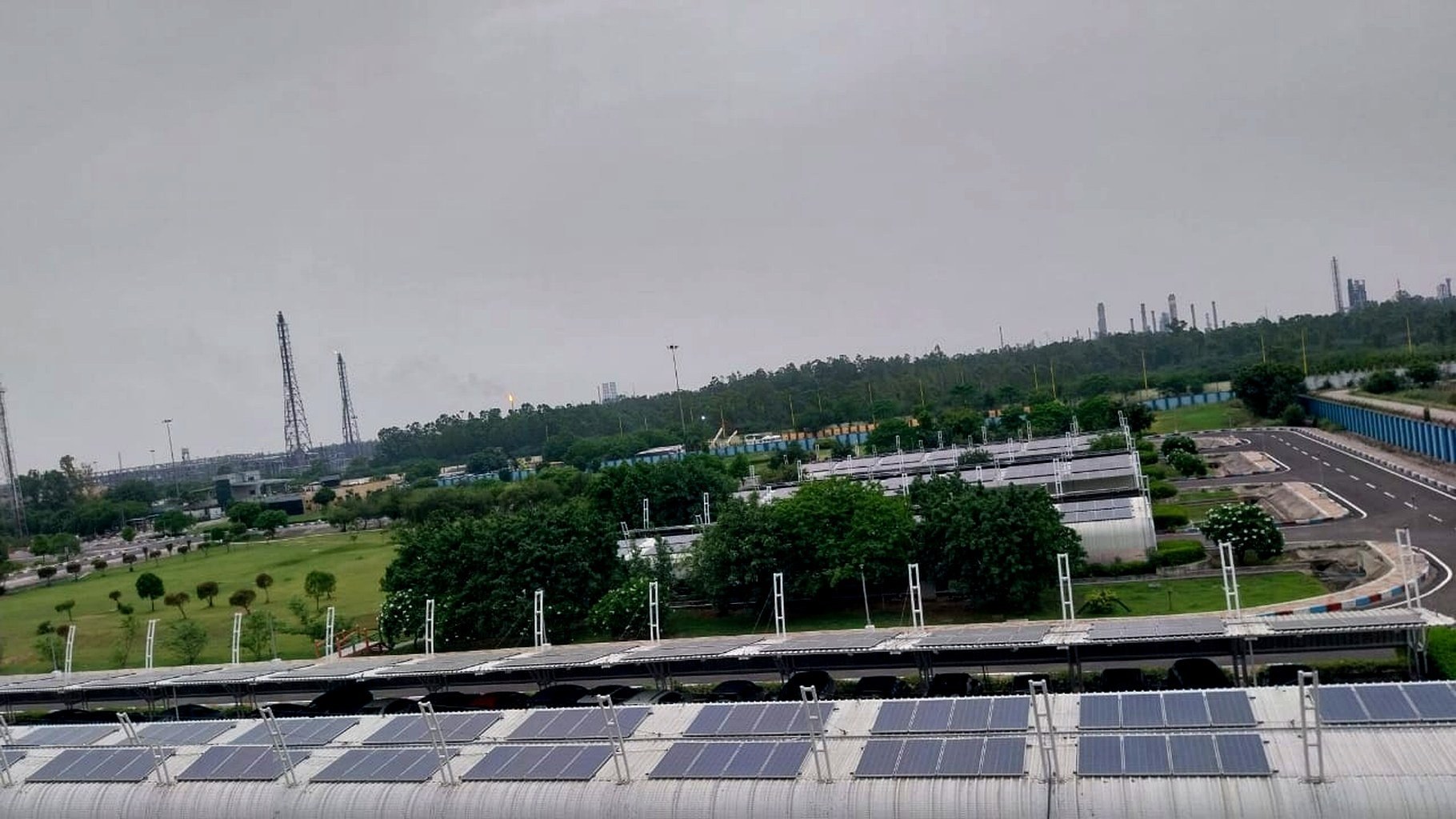
4. Warehouse / Tin-Shed Roofs
Two sites at the central store and a process-area warehouse. Corrosion profile differs sharply from RCC roofs. The mounting structure interfaces with sheet metal roofing, which expands and contracts thermally on a different schedule than the PV mounting frame. Periodic re-inspection of fastener integrity and seal weatherproofing is mandatory. Walking loads on the roof during cleaning need to be managed - tin-shed roofs cannot tolerate unrestricted foot traffic, and walkway planning becomes part of the O&M protocol rather than an afterthought.
5. Township / Residential Site
A single 50 kWp installation in residential premises. Engineering is straightforward; the complication is stakeholder management. Cleaning schedules, water usage, and noise affect resident routines. Breakdown response timing is shaped by occupant convenience as much as by technical urgency.
6. Floating Solar
A 100 kWp floating installation at a reservoir within the naphtha cracker complex - the genuinely uncommon element in this portfolio. Floating solar inside a refinery is rare in India, and the O&M regime is substantially different from any land-based typology.
The mounting platform is HDPE floaters anchored against wind and water-level variation. Inspection regimes add flotation unit integrity, anchor line tension, walkway condition, cable buoyancy (UV-resistant DC cables run through HDPE conduits), and corrosion of metallic interfaces at the water boundary. The flotation units themselves must meet ASTM D790 / ISO 178 (flexural), ASTM D638 / ISO 527 (tensile), ASTM D695 / ISO 604 (compressive), and ASTM D2565 / D4329 (UV resistance) standards. PPE includes life jackets in addition to standard refinery kit. Continuity and insulation resistance testing of DC cables follows tighter protocols because of the moisture environment. Floating solar O&M is its own discipline; treating it as rooftop solar on water leads to early degradation.
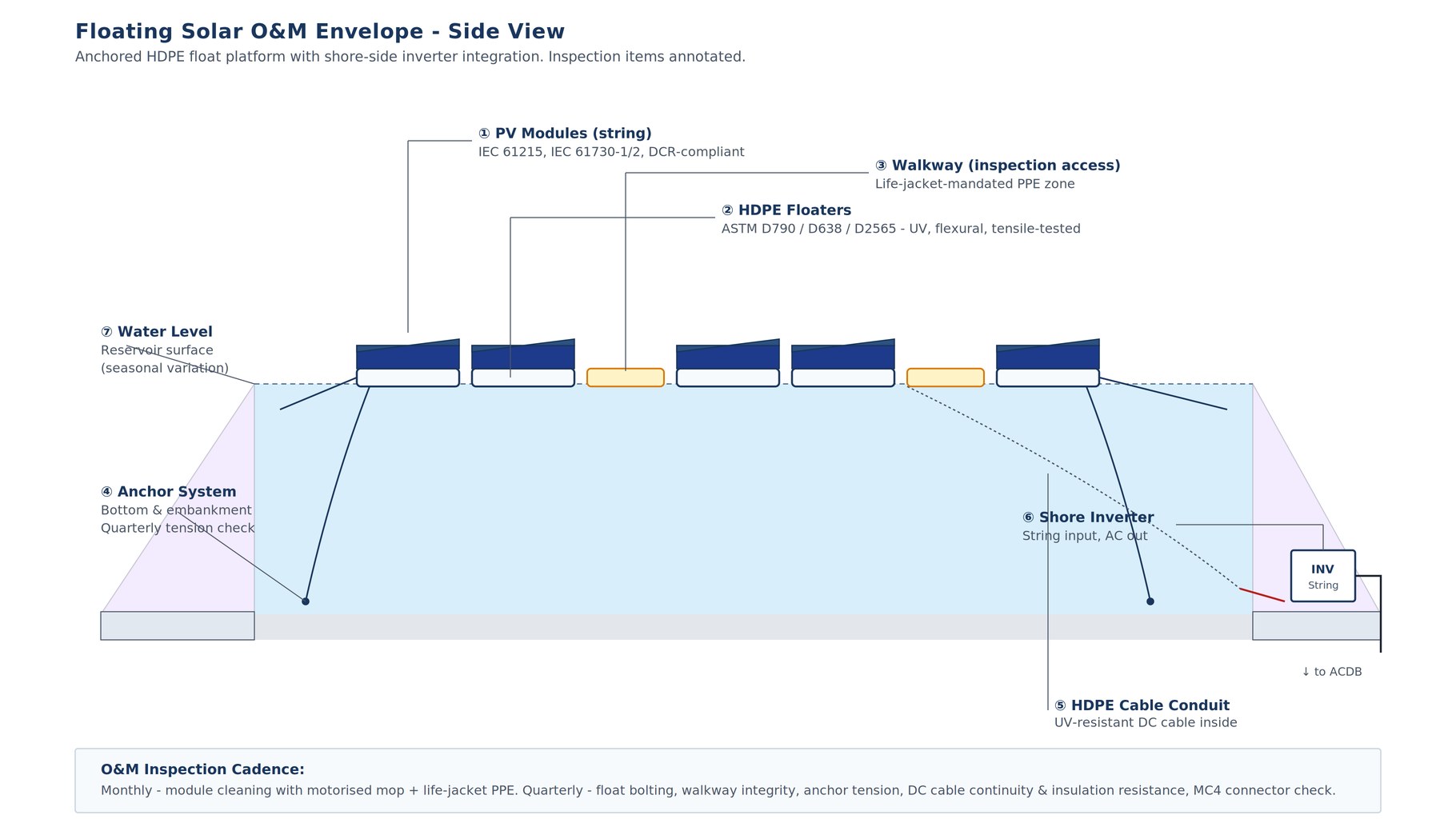
The breadth here is the headline: a vendor mobilising for this contract is effectively running six parallel O&M operations under one PTW envelope, with one shared spares pool and one supervisor pyramid.
Scope Anatomy: Rate-Based ARC vs Comprehensive O&M
The Schedule of Rates (SOR) for this contract has more than thirty individually priced line items. The structural logic is worth understanding because it is increasingly the model PSUs are adopting for solar maintenance.
What gets priced per KWp: daily monitoring, recording, reporting, and cleaning of PV modules. This is the closest line item to comprehensive O&M in conventional usage - a per-KWp rate covers the recurring daily work and bundles in petty jobs such as MC4 connector replacement for which no separate payment is allowed.
What gets priced per inverter serviced: preventive servicing of inverter populations on a lumpsum basis, where one unit equals the servicing of ten inverters of 50 kW rating or below, completed within a single visit. Inverters above 50 kW are billed proportionally - a 100 kW inverter counts as two service units.
What gets priced per event: fuse replacement, SPD replacement, inverter card replacement (categorised separately for 50 kW, 30 kW, 20 kW-and-below, and minor issues). Each repair category has its own all-inclusive rate covering parts, travel, lodging, mobile data, and packing.
What gets priced per unit: SITC of new inverters when an existing unit is beyond economic repair (50 kW, 30 kW, 20 kW, 15 kW rates), data logger SITC, enclosures, communication converters, HDPE cable laying per metre, prefabricated porta cabin, 2-ton AC for porta cabin, flotation units for the floating site.
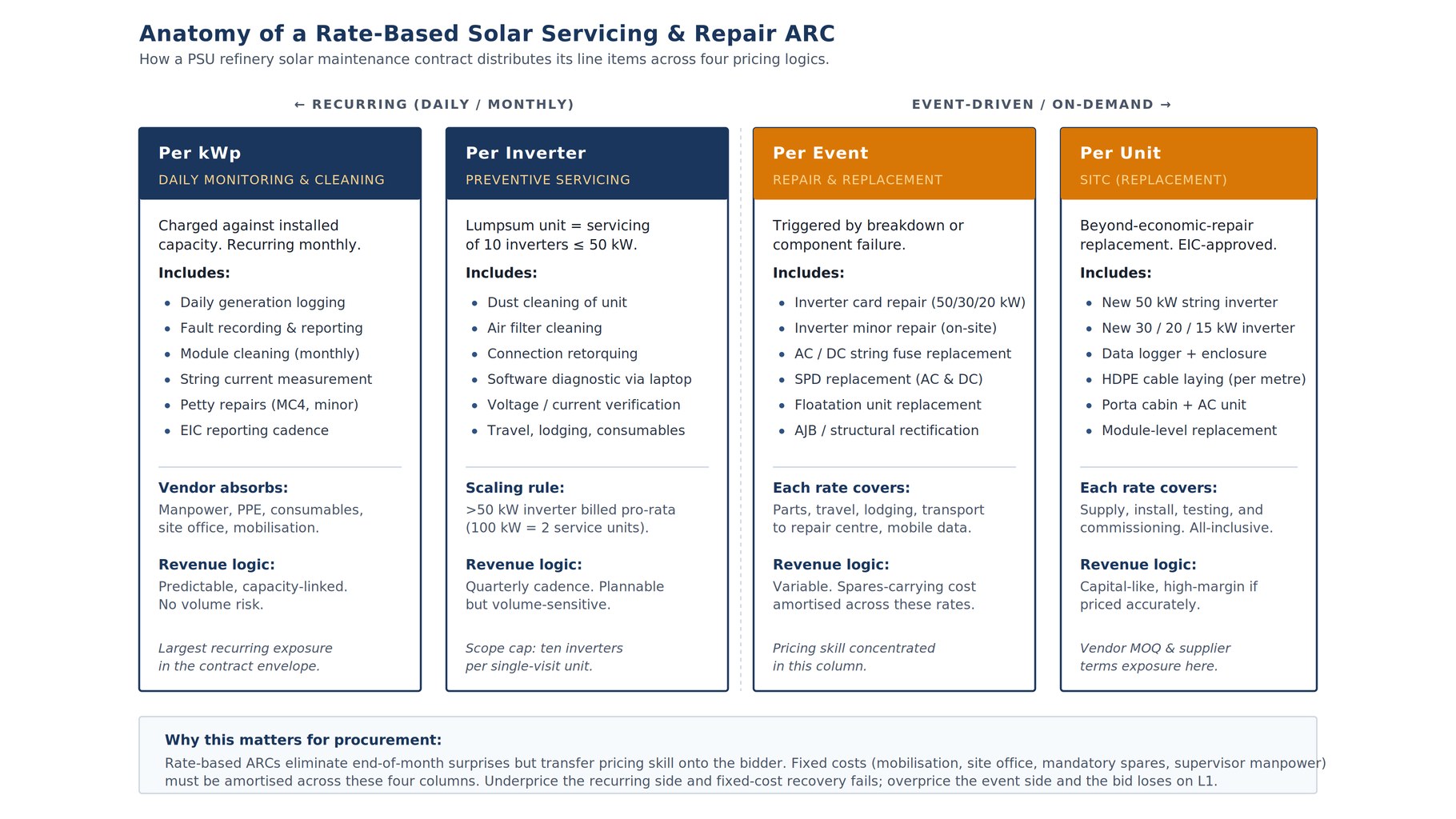
The rate-based ARC model has two consequences that procurement teams should understand. First, it is transparency-positive: every billable event maps to an SOR rate the client agreed to upfront, so there are no end-of-month surprises. Second, it shifts pricing skill onto the bidder. Fixed costs - site office, mobilisation, supervisor manpower, mandatory on-site spares, insurance, PPE - must be amortised across variable rate items. Underprice the daily monitoring rate and the fixed-cost recovery fails; overprice the repair rates and the bid loses on L1 evaluation.
This is the reason rate-based ARCs reward incumbents and discipline newcomers. There is no margin to hide in a single bundled monthly figure.
Manpower, Qualification, and the EPFO Compliance Layer
The contract specifies a minimum manpower envelope of four semi-skilled technicians plus one supervisor at each cluster - one cluster at the naphtha cracker complex and a second at the refinery-plus-aromatics cluster - for a floor of ten personnel on site throughout the 24-month duration. Qualification minimums are codified: the supervisor cum safety supervisor must hold an ITI Electrical certificate or higher with at least three years' solar installation/maintenance experience; semi-skilled technicians must hold an ITI Electrical certificate with one year of experience, or matriculation with three years' industrial experience. Skill testing to verify experience can be invoked by the EIC.
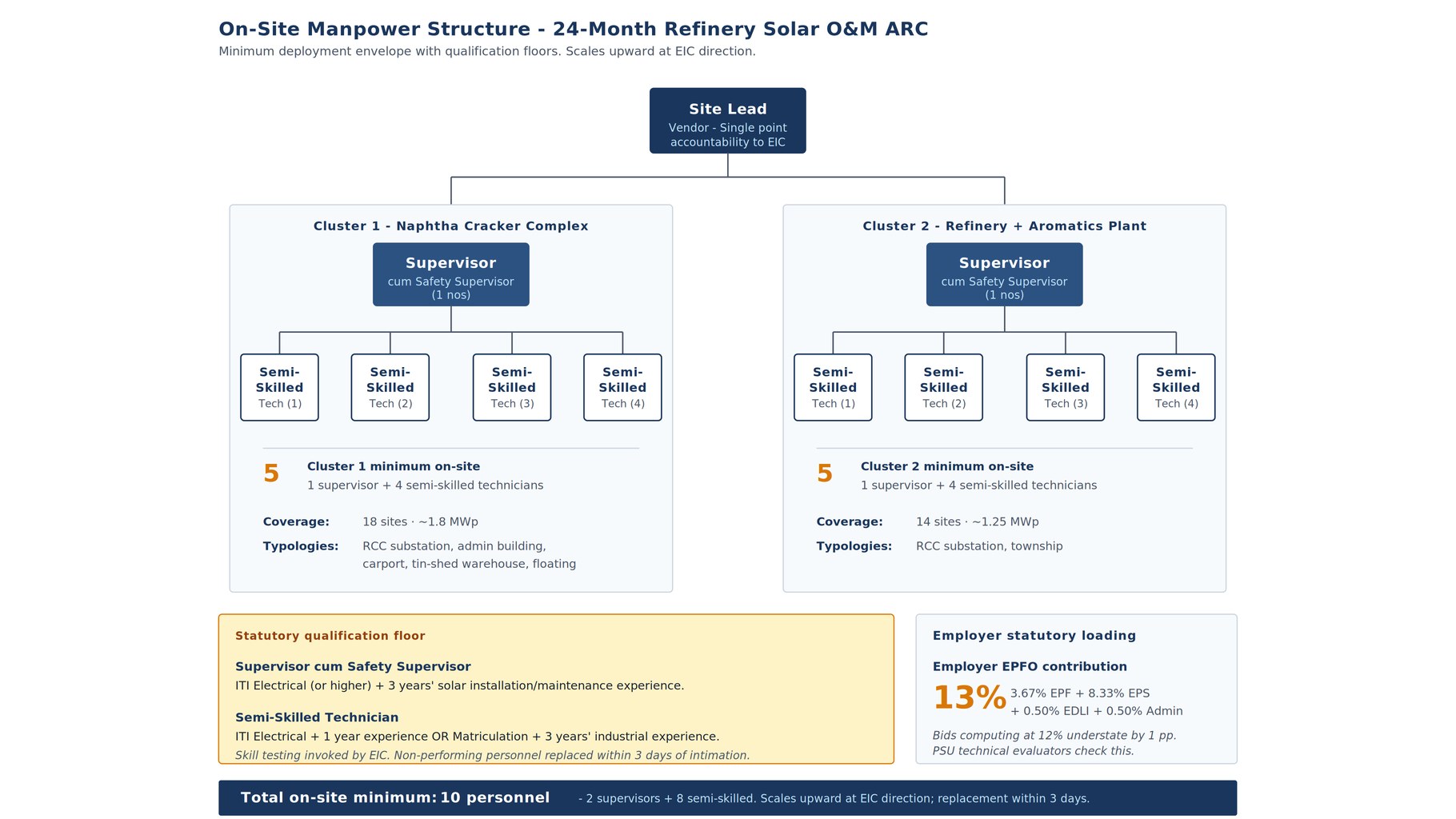
Where this gets commercially interesting is in statutory compliance loading. Under the Employees' Provident Funds Act, employer contribution to EPFO is 13 per cent of basic plus DA - comprising 3.67 per cent towards EPF, 8.33 per cent towards EPS, 0.50 per cent towards EDLI, and 0.50 per cent towards administrative charges. Employee contribution adds 12 per cent. Workmen compensation insurance, ESI where applicable, bonus, and leave wages compound the loading further.
A bidder who computes manpower cost at 12 per cent employer EPFO contribution (a common error) under-states statutory cost by a full percentage point of the manpower base. Across a 24-month contract with ten personnel, that is not a trivial figure. PSU procurement teams scrutinising L1 bids increasingly check labour-compliance assumptions during technical evaluation precisely because under-stated compliance loadings show up later as wage disputes, contract-labour licensing issues, or DGM(Contract) audit findings.
For procurement teams writing such RFPs, asking bidders to attach their Form 5A, PF code, ESI registration, and labour licence - and to declare the EPFO contribution rate they have computed in their unit rates - is a low-effort, high-yield screen.
The Refinery Standards Stack
The technical specifications invoked across the SOR are a useful reference for anyone scoping similar work:
- PV modules: IEC 61215 (design qualification), IEC 61730-1 and IEC 61730-2 (safety construction and testing), IS 14286, IEC 62804 (PID resistance). Mandatory domestic manufacturing under MNRE's Domestic Content Requirement (DCR). Photoelectric conversion efficiency at least 15.5%, fill factor at least 72%, glass transmittance at least 91%.
- Junction boxes and enclosures: IEC 60529 (IP65/IP66), IEC 61439-1 (low-voltage switchgear assemblies), IEC 60695-2-11 (glow wire test at 960C/850C), UL94-V-0/V-2 (burning behaviour), RoHS Directive 2002/95/EC.
- Surge protection: IEC 61643-1 Class II SPDs at array junction boxes, nominal discharge current at least 10 kA at 8/20 microseconds, maximum discharge current at least 20 kA at 8/20 microseconds.
- Inverters: IEC 62109-1 and IEC 62109-2 (safety), VDE-AR-N 4105 and VDE 0126-1-1 (anti-islanding), EN 61000-6-2 and EN 61000-6-4 (electromagnetic compatibility), IP65 ingress protection, peak efficiency at least 98%.
- Flotation systems (floating solar): ASTM D790 / ISO 178, ASTM D638 / ISO 527, ASTM D695 / ISO 604, ASTM D2565 / D4329 / G7-G7M-11, ASTM D1693 (environmental stress crack resistance).
- Contractor licensing: Valid Electrical Contractor's Licence for 415 V and above, endorsed for the state of execution. Out-of-state licences require gazette-prescribed endorsement procedures.
This stack is what separates a technically credible bid from one that gets returned in the first round of evaluation.
Spares Strategy: What Sits On-Site
A rate-based ARC requires the vendor to hold a defined critical-spares envelope on site at all times, irrespective of consumption history. The mandatory minimum is small but specific:
- 2 PV modules of the prevailing site rating
- 1 DC distribution box per the SOR specification
- 1 set of AC and DC SPDs plus string input fuses
- 100 m of UV-resistant solar cable in two bundles (red and black)
- 20 MC4 connector pairs
- 100 m of copper wire
The economic logic is response-time-driven: a substation auxiliary supply tied to a faulty inverter cannot wait for OEM lead time. The vendor absorbs holding cost in exchange for the right to bill replacement events at SOR rates as they occur. New inverters, data loggers, flotation units, and major-issue repair parts are mobilised as needed under their own SOR line items.
A common bidding error is to load the daily-monitoring KWp rate with full spares-amortisation cost - a strategy that often fails L1 evaluation. Spares cost is more efficiently amortised across the per-event repair and SITC rates, where consumption pattern justifies the loading.
Records, Reporting, and the Cadence
The reporting regime is daily, monthly, and quarterly - and it is monitored.
Daily: voltage, current, and energy generation per inverter; fault type, time, and duration; on/off/faulty status of each unit. Submitted to the EIC in the standard format prescribed at contract start.
Monthly: complete record of panel cleaning per site; inverter and SPD inspection logs; cumulative generation against design expectations.
Quarterly: structural nut and bolt inspection with retorquing; floater bolt inspection at the floating solar site; full preventive maintenance of inverters with connection tightness verification; loose-cable-termination checks between PV modules, arrays, and ACDB; MC4 connector inspection and replacement; earthing continuity verification for both module frames and mounting structures.
Records are vendor-borne - the client provides format, the contractor provides stationery, software, and submission discipline.
Five Lessons for Procurement Teams Writing Their Own RFP
For procurement engineers and energy managers at refineries, large process plants, and PSU complexes preparing their own solar O&M RFPs, this contract structure suggests five takeaways.
- Rate-based ARCs beat lump-sum comprehensive O&M when the asset base is heterogeneous. Six mounting typologies, multiple inverter ratings, and varied site access make a single bundled monthly fee either over-priced (vendor protects against uncertainty) or under-priced (vendor under-provisions and degrades service). Rate-based structures align cost to actual work executed.
- Codify mounting-typology-specific protocols inside the SOR, not as an afterthought. Floating solar, carport, tin-shed, and rooftop solar are different disciplines. A single cleaning rate applied uniformly under-rewards typologies with higher soiling and over-rewards low-effort sites.
- Screen labour-compliance assumptions during technical evaluation. Ask for EPFO contribution rate, ESI registration, contract labour licence, workmen compensation policy, and Form 5A. Bids that under-state these by even one percentage point are not L1 winners; they are L1 problems.
- Define the critical-spares envelope in the SOR itself. Leaving spares to vendor discretion produces predictable disputes during breakdown events. A codified minimum spares list, refreshed at consumption, removes the friction.
- Build the PTW interface into the contract, not into the kick-off meeting. Specify expected daily permit volumes, IFR/PPE provisions, hot-work coordination procedures, and breakdown-response protocols inside the scope. Vendors who price for a casual PTW environment fail inside operating refineries.
Frequently Asked Questions
What is included in a solar O&M ARC at a PSU refinery in India?
A comprehensive solar O&M ARC at a PSU refinery typically covers daily monitoring and module cleaning, monthly inverter servicing, quarterly structural and electrical inspections, breakdown response with 24x7 availability, mandatory on-site spares (PV modules, fuses, SPDs, MC4 connectors, UV-resistant cable), and supply-installation-testing-commissioning of replacement equipment when failures occur. The scope is governed by the host plant's Permit-to-Work system, area classification requirements, and IFR/PPE protocols specific to hazardous-area operations.
How does a rate-based solar O&M ARC differ from comprehensive lump-sum O&M?
A rate-based ARC prices each task individually: per kWp for daily monitoring and cleaning, per inverter for preventive servicing, per event for repair and component replacement, and per unit for new equipment SITC. A comprehensive lump-sum O&M bundles all of this into a single fixed monthly fee. Rate-based ARCs are transparency-positive (every billable event maps to an agreed rate) but shift pricing skill onto the bidder, who must amortise fixed costs like manpower and mobilisation across variable rate items.
What is the minimum manpower required for solar O&M at a PSU refinery?
Indian PSU refinery solar O&M contracts typically specify a minimum of one supervisor cum safety supervisor plus four semi-skilled technicians per plant cluster. Across a multi-cluster portfolio, this means 10 personnel on-site minimum throughout the contract duration. Qualifications are codified: supervisors need ITI Electrical (or higher) plus 3 years of solar maintenance experience; technicians need ITI Electrical with 1 year experience or matriculation with 3 years of industrial experience.
What is the employer EPFO contribution rate for Indian solar O&M contracts?
The employer EPFO contribution is 13 percent of basic plus DA, comprising 3.67 percent towards EPF, 8.33 percent towards EPS, 0.50 percent towards EDLI, and 0.50 percent towards administrative charges. The employee contributes an additional 12 percent. Bidders who compute manpower cost at 12 percent employer EPFO understate statutory cost by a full percentage point of the manpower base, which over a 24-month, 10-person contract is a significant misstatement that PSU technical evaluators increasingly screen during L1 evaluation.
How is floating solar O&M different from rooftop solar O&M?
Floating solar O&M adds inspection items that rooftop O&M does not: flotation unit integrity, anchor line tension, walkway condition, cable buoyancy through HDPE conduits, and corrosion of metallic interfaces at the water boundary. Flotation units must meet ASTM standards for UV resistance, flexural strength, tensile strength, and compressive strength. PPE includes life jackets in addition to standard PPE. DC cable continuity and insulation resistance testing follows tighter protocols because of the moisture environment. Treating floating solar O&M as 'rooftop solar on water' leads to early degradation.
What standards apply to solar PV maintenance at Indian refineries?
Indian refinery solar O&M typically invokes: IEC 61215 (PV module design qualification), IEC 61730-1 and IEC 61730-2 (PV safety), IS 14286 (Indian PV standard), IEC 62804 (PID resistance), IEC 60529 (IP65/IP66 ingress protection), IEC 61439-1 (LV switchgear assemblies), IEC 61643-1 (surge protection), IEC 62109-1 and IEC 62109-2 (inverter safety), VDE-AR-N 4105 (anti-islanding), UL94-V-0/V-2 (burning behaviour), and RoHS Directive 2002/95/EC. Modules must be MNRE-approved under Domestic Content Requirement. Contractors require valid Electrical Contractor Licence endorsed for the state of execution.
How does the Work Permit System affect solar maintenance work at a refinery?
The host refinery's Permit-to-Work (PTW) system gates every solar maintenance job. A routine job traverses permit application, hazard identification with area classification check, isolation confirmation on both DC and AC sides with LOTO where required, toolbox briefing with PPE verification, work execution under EIC oversight, and permit closeout. Hot-work permits are required for any sparking, welding, or open-flame activity near hazardous areas; cold-work permits suffice for cleaning and most PV-side maintenance. Permit volume scales with site count, not module count, so a portfolio with many small installations carries higher administrative load than one large array.
What spares must a vendor maintain on-site for refinery solar O&M?
Indian PSU refinery solar O&M contracts typically specify a mandatory on-site critical-spares envelope: 2 PV modules of the prevailing site rating, 1 DC distribution box, 1 set of AC and DC surge protection devices plus string input fuses, 100 metres of UV-resistant solar cable in two bundles (red and black), 20 MC4 connector pairs, and 100 metres of copper wire. The economic logic is response-time-driven: a substation auxiliary supply tied to a faulty inverter cannot wait for OEM lead time. The vendor absorbs holding cost in exchange for the right to bill replacement events at agreed rates as they occur.
About MGetEnergy
MGetEnergy is an Indian solar EPC firm with O&M and hybrid solar+BESS capabilities, working across PSU and large C&I segments. Active O&M engagements include a 24-month rate-based servicing and repair ARC at a North Indian PSU refinery complex spanning six mounting typologies, alongside hybrid solar+BESS deployments for industrial captive consumers evaluating diesel displacement and open-access optimisation. If your facility is weighing whether battery storage makes sense, our C&I BESS decision framework walks through the five factors that decide it. For procurement teams scoping similar contracts - refinery solar O&M, process-plant solar maintenance, multi-typology portfolios, or floating solar O&M - MGetEnergy can be reached at wecare@mgetenergy.com or +91 98218 76325.